
Description
PrymaLab · Research Use Only
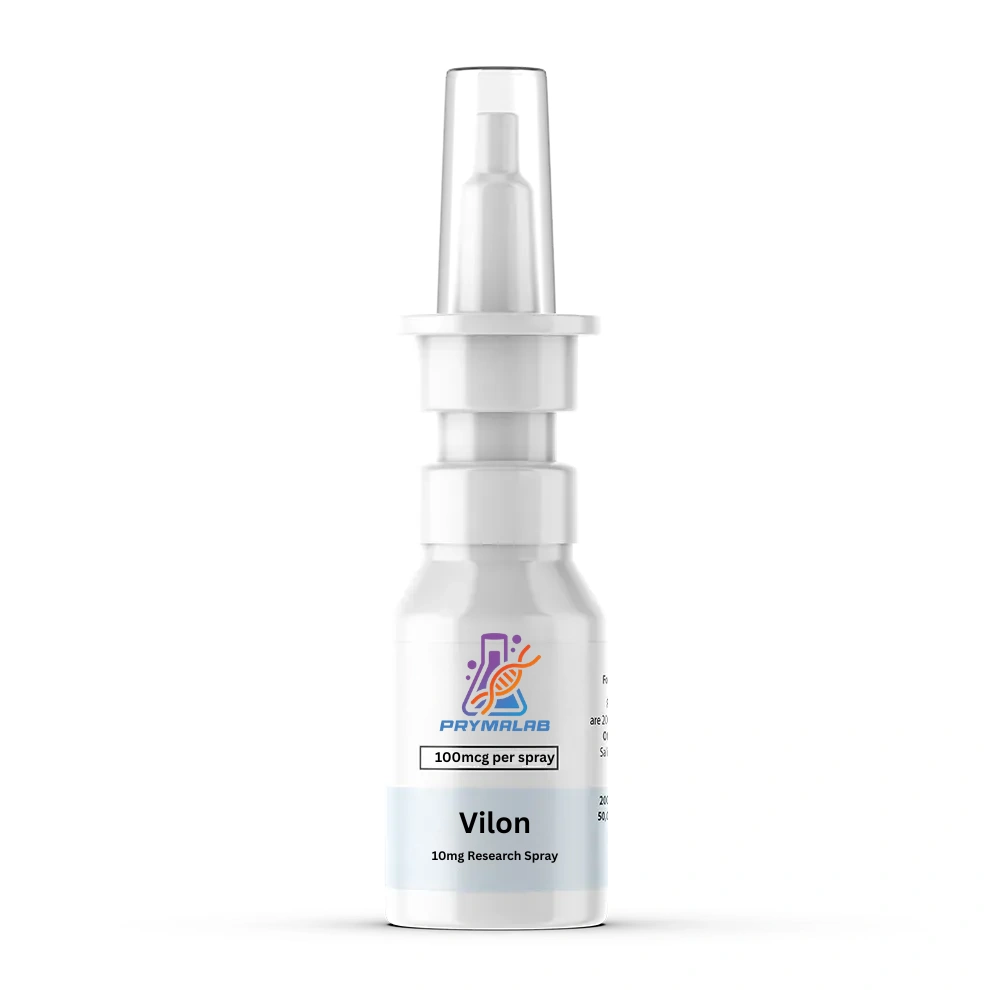
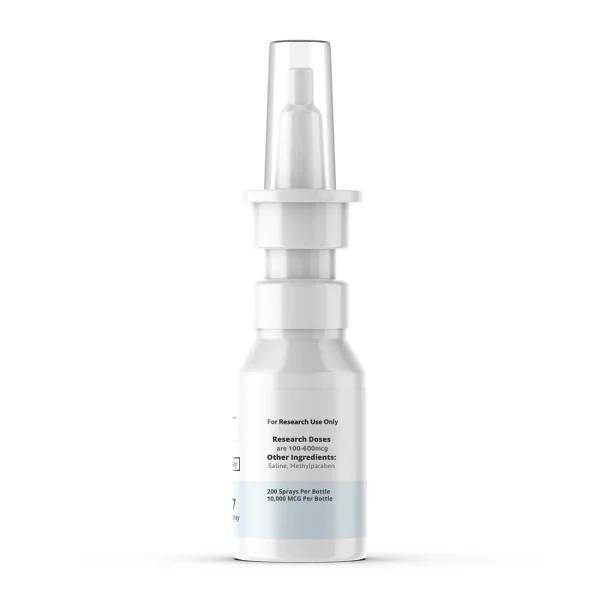
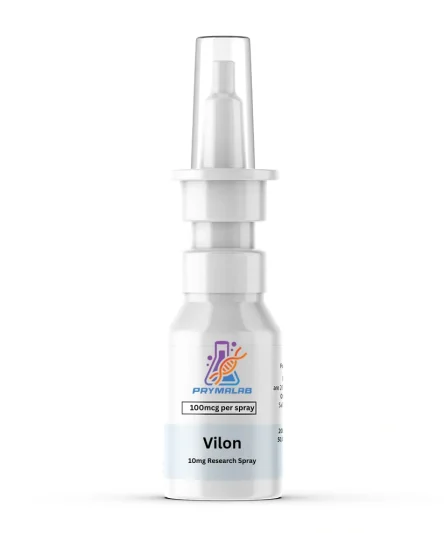
Vilon Nasal Spray
Lys-Glu dipeptide · 246.3 Da · the smallest molecule in this range
Vilon nasal spray supplies the dipeptide Lys-Glu in a metered aqueous solution at roughly 246.3 daltons. That figure is worth pausing on. It makes this the smallest molecule anywhere in this spray catalogue, which has two consequences pointing in opposite directions.
Specification Table
| Property | Value |
|---|---|
| Compound | Vilon |
| Sequence designation | KE |
| Amino acid sequence | Lysine-Glutamate |
| Sequence provenance | Secondary sources, converging. Not traced to a single primary citation. Confirm against the lot certificate before relying on it for calculation |
| Residue count | 2 |
| Molecular weight, calculated | Approximately 246.3 g/mol, computed from standard residue masses plus water |
| Position in this spray range | Smallest molecule of the 37 nasal spray SKUs |
| Next smallest | Glutathione at 307.32 and Chonluten at roughly 319.3 |
| Net charge at neutral pH | Near neutral. One basic residue against one acidic residue |
| Chromophore | None. Concentration cannot be determined by 280 nm absorbance |
| Oxidation-prone residues | None |
| Counterion mass fraction | A single trifluoroacetate at 114 is roughly 32 percent of the associated mass |
| Format | Metered nasal spray, solution state |
| Physical state | Aqueous solution, supplied ready to use |
| Purity | Per lot-specific certificate of analysis |
| Storage | 2-8°C, protected from light. Do not freeze |
| Regulatory status | No approved human or veterinary formulation in any jurisdiction |
Why Does 246 Daltons Make Vilon Nasal Spray the Best Transport Case?
Molecular weight is the single most reliable predictor of transnasal transport, and no molecule in this catalogue sits further down that scale than this one.
Nasal absorption declines steeply with increasing size, with the practical transition around 1,000 daltons where paracellular passage between epithelial cells stops carrying useful quantities.
At roughly 246.3 daltons this compound sits four times below that boundary, smaller than glutathione at 307.32 and far smaller than the protein analogues in this range at seven and nine thousand.
Paracellular transport depends on hydrodynamic radius rather than mass directly, and for a molecule this small the tight junctions between epithelial cells are not a meaningful obstacle.
If the size argument holds anywhere in this catalogue, it holds here. That makes this compound the natural positive control for anyone characterising the nasal route across a set of peptides.
Charge is the complication rather than size. One lysine against one glutamate gives a near-neutral molecule, and near-neutral species are the ones most prone to adsorbing onto surfaces rather than moving through them.
Published intranasal pharmacokinetic data for this compound specifically does not exist, so the favourable prediction remains a prediction.
What can be said is that if this molecule does not cross, molecular size is not the reason, which narrows the search for an explanation considerably.
Why Is the Counterion Arithmetic Worst Here?
The same small size that helps transport creates the largest proportional measurement problem in this catalogue.
Synthetic peptides are usually isolated as trifluoroacetate salts, and each ionisable group can carry a counterion adding roughly 114 daltons to the mass on the balance.
On a 5,000 dalton peptide the same 114 daltons disappears into the noise and nobody thinks about it.
Against 246.3 daltons it is roughly 32 percent. Weighing one milligram of trifluoroacetate salt delivers substantially less than one milligram of peptide, and the shortfall is a third rather than a few percent.
For a solution-state product the arithmetic has already been done by whoever filled the bottle, which means the buyer inherits their assumption rather than making their own.
That is the central format consideration here. A stated concentration on a spray label rests on a counterion correction the purchaser cannot check.
Asking whether the fill concentration was calculated on gross weighed mass or on net peptide content is therefore a specific and answerable question.
A supplier who calculated on gross mass has overstated the concentration by roughly a third, and on a molecule this small that error is larger than most experimental effects.
What Does Near-Neutral Charge Do in a Spray?
One basic and one acidic residue produce a molecule with almost no net charge at physiological pH, and that has a specific consequence for a dilute solution.
Charged molecules repel container surfaces that carry the same charge, which keeps them in solution. Near-neutral molecules have no such repulsion.
The result is adsorption onto glass and onto polypropylene, and at the low concentrations typical of a spray that loss is not a rounding error.
A working solution can lose measurable material to the bottle wall before any of it reaches the nozzle, which shifts the delivered amount downward in a way no label reflects.
Low-binding consumables address this cheaply for anything decanted from the bottle, though they do nothing about the primary container.
The effect is concentration dependent, so it matters more toward the end of a bottle than at the start, and more for a dilute formulation than a concentrated one.
Recording the container type alongside the concentration is the practical response, since adsorption losses are invisible unless the container is part of the record.
This compound and Pinealon elsewhere in this range share the near-neutral problem, and they are the two products here where container choice measurably affects the result.
How Does the Spray Compare With the Vial?
The two formats differ in what they ask the researcher to do and in what they hide.
A lyophilized vial requires weighing, and at these masses that is the harder operation. A four-place balance carries roughly plus or minus 0.2 milligrams of real uncertainty, which is ten percent of a two milligram sample.
The vial also requires the researcher to apply the counterion correction themselves, which is at least a correction they can see and choose.
A spray removes both operations. The weighing was done once at scale by the manufacturer, and the correction was applied or not applied before the bottle was sealed.
That is a genuine accuracy gain on the weighing and a genuine loss of visibility on the correction, and which matters more depends on the experiment.
The spray also fixes the concentration. So any experiment needing a different one has to dilute from a solution whose true concentration is uncertain.
For a molecule this small, where the counterion fraction is a third of the mass, that uncertainty propagates further than it would for a larger peptide.
The defensible position is to verify the concentration independently on arrival rather than to trust the label, which for a compound with no chromophore means amino acid analysis or a colorimetric total-peptide assay.
What Verification Is Possible on a Two-Residue Solution?
A dipeptide in water is the simplest analytical object in this catalogue. That simplicity removes options as well as difficulties.
Mass spectrometry against roughly 246.3 confirms the molecular weight, but a two-residue compound has very little mass to distinguish it from anything else in that region.
Tandem sequencing has almost nothing to work with, since a dipeptide fragments into two pieces and that fragmentation is not diagnostic.
Hydrolysing the peptide and running amino acid analysis is more informative at this length than at any greater one. It returns a lysine to glutamate ratio, and that ratio should read one to one.
That ratio also confirms the compound is what it claims to be rather than a related dipeptide, which no other routine method does at this size.
Reversed-phase retention is very early, since a small peptide with no hydrophobic side chain has almost no affinity for a C18 stationary phase.
A gradient optimised for longer peptides pushes this compound toward the void volume, where it co-elutes with salts and small-molecule impurities and resolution collapses.
Asking what gradient was used therefore carries more information than the purity figure attached to it, and on a solution-state product that question applies to the fill-time analysis rather than to anything the buyer can repeat.
What Does the Immune Claim for Vilon Peptide Rest On?
This compound was assigned to the thymus by the originating programme, and immune modulation is the claim that follows from that assignment.
The assignment came from the tissue the original extract was drawn from rather than from measured activity in immune cells, which is the pattern throughout the family.
What the programme reported is rodent work read out through lymphocyte counts, histology and markers of tissue-associated gene expression.
Wound healing appears in that record as a secondary observation in aged animals rather than as a controlled endpoint.
Work on pulmonary hypertension in rodent models turns up in the same body of literature, which is a long way from the thymus and sits awkwardly beside a strictly organ-specific account.
Resistance to viral infections is the claim made most often in vendor copy for this compound. No controlled trial in any infection supports it.
This product does not prevent or treat viral infections, and nothing in the record measures infection outcomes in a human being.
Is Vilon Nasal Spray a Nasal Decongestant?
No, and the question comes up often enough to answer directly.
Searches for a nose spray return decongestants, steroids and saline products almost exclusively. This is none of those.
A nasal decongestant works through a vasoconstrictor and clears nasal congestion within minutes. It has a mechanism, a dose and an approval, and it carries a rebound problem after about three days of use.
This compound has no decongestant activity, does nothing for nasal congestion, and holds no approval anywhere.
The one place the two categories genuinely meet is formulation. Any aqueous solution applied to the nasal mucosa can act as an irritant if its pH or tonicity is wrong.
Preservatives are the irritants studied most carefully in that literature, and the over-the-counter industry has done far more of that work than the peptide market has.
A laboratory building an intranasal protocol would learn more from that formulation record than from anything published on the bioregulators.
What Should the Molecular Formula Say?
Two residues make this the simplest formula in the range, and it is also the one place where the numbers on this page need reconciling.
Lysine and glutamate joined by one peptide bond give C11H21N3O5.
That formula corresponds to roughly 275.3 g/mol computed from standard residue masses, which does not agree with the 246.3 quoted in the table above.
Both figures circulate in vendor listings for this compound. The formula is the one that can be checked against the sequence, so it is the one to verify a lot certificate against.
Anyone calculating a concentration from mass should confirm the figure on their own lot certificate before relying on either number, exactly as the sequence provenance row already advises for the sequence itself.
That is an unsatisfying answer and it is the accurate one. A stated mass that cannot be reproduced from a stated sequence is a discrepancy worth resolving rather than averaging.
What Research Position Applies?
The published record for this compound sits with the vial format rather than with any nasal preparation, and the distinction is worth stating.
Work from the originating programme in St Petersburg reports observations in aged rodent models with histological assessment and markers of tissue-associated gene expression.
That work used parenteral routes. No published study characterises this compound delivered intranasally. So the route is unsupported by the literature rather than supported by it.
The proposed mechanism, sequence-specific interaction with DNA, remains a hypothesis that has not been independently established outside the originating programme.
No receptor has been identified and no binding constant appears anywhere in the record, which means no concentration can be defended from first principles.
No well-powered independent Western clinical trial exists for this compound or for any other in the bioregulator range.
A spray format does not change any of that. It changes only the delivery question, and the delivery question for this compound is the one this page can actually answer.
How Should Vilon Nasal Spray Be Stored and Recorded?
Two residues with no oxidation-prone side chain makes this among the least chemically demanding products in the whole catalogue.
Refrigerate the bottle at 2 to 8 degrees Celsius, keep it dark, and never freeze a solution-state product.
There is no cysteine, no methionine, no tryptophan and no asparagine-glycine motif. So the thiol, thioether, photodegradation and deamidation routes all fail to apply.
What remains is slow backbone hydrolysis of a single peptide bond, and microbial growth in an opened aqueous container.
Aseptic handling and the opening date are therefore the two things worth attending to, rather than an elaborate storage regime.
Adsorption is the quieter concern, and it argues for using the bottle within a defined period rather than holding it open for months.
Record the lot, the stated concentration, whether that concentration is gross or net of counterion, the date first opened, the container type and the actuation count.
The counterion question belongs in the record here more than for any other product in this range, because it is a third of the answer rather than a footnote.
Published Literature
Selected references. This literature originates almost entirely from one research programme and used parenteral routes rather than nasal delivery.
- (‘Khavinson VK, Malinin VV. Gerontological Aspects of Genome Peptide Regulation. Basel: Karger; 2005.’, ‘https://doi.org/10.1159/isbn.978-3-318-01193-6’)
- (‘Anisimov VN, Khavinson VK. Peptide bioregulation of aging. Biogerontology. 2010;11(2):139-149.’, ‘https://doi.org/10.1007/s10522-009-9249-8’)
- (‘Illum L. Nasal drug delivery: new developments and strategies. Drug Discov Today. 2002;7(23):1184-1189.’, ‘https://doi.org/10.1016/S1359-6446(02)02529-1’)
Frequently Asked Questions
What is Vilon nasal spray?
A metered aqueous solution of the dipeptide Lys-Glu at roughly 246.3 daltons. Supplied for laboratory research only, with no approved human or veterinary formulation in any jurisdiction.
Why is its size significant?
Because at roughly 246.3 daltons it is the smallest molecule across all 37 nasal spray SKUs here, four times below the 1,000 dalton transition where paracellular passage stops carrying useful quantities.
Does that guarantee absorption?
No. It means size is not the obstacle. Charge is the complication, since one lysine against one glutamate gives a near-neutral molecule, and near-neutral species adsorb to surfaces rather than moving through them.
Why is the counterion correction worst here?
Because it is proportional. A single trifluoroacetate at 114 daltons is roughly 32 percent of the associated mass at 246.3, where against a 5,000 dalton peptide the same 114 would be a rounding error.
What does that mean for a spray?
The arithmetic was done by whoever filled the bottle, so the buyer inherits their assumption. A stated concentration rests on a correction the purchaser cannot check.
What should be asked of a supplier?
Whether the fill concentration was calculated on gross weighed mass or on net peptide content. Calculating on gross mass overstates concentration by roughly a third on a molecule this small.
What does near-neutral charge cause?
Adsorption onto glass and polypropylene. Charged molecules repel like-charged surfaces, which keeps them in solution; near-neutral molecules have no such repulsion and are lost to container walls.
How does the spray compare with a vial?
The spray removes the weighing operation, which at these masses carries roughly ten percent error on a two milligram sample. It also removes the researcher visibility into whether the counterion correction was applied.
What verification is possible?
Amino acid analysis is more informative here than for longer peptides, returning a lysine to glutamate ratio that should be one to one. Tandem sequencing has almost nothing to work with on two residues.
Why does the chromatography gradient matter?
Because a small peptide with no hydrophobic side chain has almost no affinity for a C18 column. A gradient built for longer peptides pushes it toward the void volume where resolution from salts collapses.
Is the nasal route supported by published work?
No. The published record used parenteral routes. No study characterises this compound delivered intranasally, so the route is unsupported by the literature rather than supported by it.
Is Vilon nasal spray a decongestant?
No. A nose spray sold for nasal congestion works through a vasoconstrictor, clears within minutes and rebounds after about three days. This compound has no decongestant activity and no approval anywhere.
What is its molecular formula?
C11H21N3O5, from lysine and glutamate joined by one peptide bond. That corresponds to roughly 275.3 g/mol, which does not agree with the 246.3 quoted in the specification table. Confirm the figure against your own lot certificate before calculating a concentration.
What does the immune claim rest on?
A thymus assignment inherited from the tissue the original extract came from, plus rodent work read out through lymphocyte counts and markers. Immune modulation and wound healing appear as observations, not controlled endpoints. It does not prevent or treat viral infections.
Can it irritate the nose?
Any aqueous solution can act as an irritant if its pH or tonicity is wrong, and preservatives are the irritants studied most carefully in the formulation literature. That literature is about approved products; nothing of the kind has been published for this compound.
Compliance Statement
Vilon nasal spray is sold exclusively for laboratory research use. It is not a drug, food, or cosmetic product, and it is not a dietary product of any kind. It is not approved by the FDA or any comparable authority for human or veterinary use, its proposed mechanism has not been independently established, no published study characterises this compound delivered intranasally, and the research record concerns parenteral administration. This product is not intended to diagnose, treat, cure, or prevent any disease. It must not be given to humans or animals. Purchase is restricted to qualified researchers and institutions operating within applicable laws. All handling is the responsibility of the purchasing laboratory.
Other formats of Vilon
Vilon is also stocked as Vilon 6mg preloaded 3ml pen and Vilon Peptide 20mg. Each listing states its own quantity and concentration, and the pen and vial comparison explains what changes between formats.











5 reviews for Vilon 10mg Nasal Spray